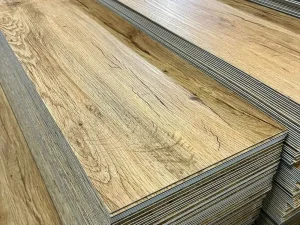
Featured High-Performance Product Portfolio
Explore our export-grade, precision-engineered polymer substrates, cellular PVC sheets, and specialized structural formwork engineered for international building codes and industrial standards.
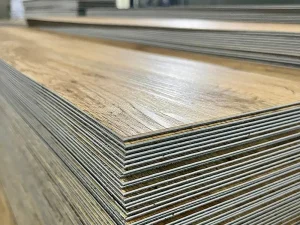
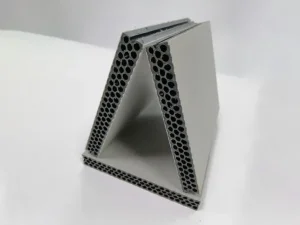
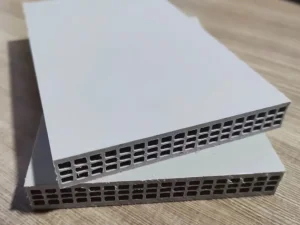
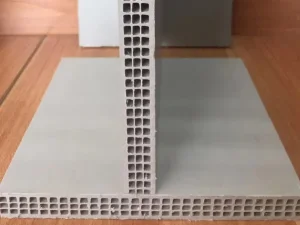
Macro Industry Solutions & Polymer Physics of Expanded PVC Sheets
Expanded Polyvinyl Chloride (Expanded PVC sheet), frequently referred to in structural engineering as cellular PVC foam board, represents a major chemical engineering leap forward in solid polymer substitution. By incorporating a controlled closed-cell micro-foaming matrix during continuous screw extrusion, Chinese manufacturers have unlocked a material that pairs structural rigidity with low bulk density (ranging from 0.40 g/cm³ to 0.85 g/cm³).
When evaluating China Expanded PVC Sheet Suppliers & Exporters, industrial buyers must look beyond basic dimensions to analyze the fundamental rheological parameters of the PVC melt. The process relies on masterbatch formulations integrating chemical blowing agents (such as azodicarbonamide), acrylic processing aids for foam core stabilization, and heat stabilizers (calcium-zinc or organotin matrix systems). The resultant microcellular structure exhibits near-zero water absorption, making it intrinsically superior to hygroscopic cellulosic materials like plywood and MDF.
Celuka Extrusion Technology
The Celuka process utilizes a cooled mandrel die internal structure, forcing the expanding polymer melt to form a high-density, smooth solid skin over a foamed core. This yields exceptional flexural modulus and scratch resistance, ideal for exterior architectural trim, marine cabinetry, and heavy-duty industrial cladding.
Free-Foam Process Optimization
Free-foam extrusion permits unrestricted expansion of the polymer formulation upon exiting the die head. This creates a uniform cellular distribution from core to surface with a matte finish. Free-foam sheets offer superior flexibility, ease of thermoforming, and weight reduction for wide-format digital printing and sign display systems.
Co-Extrusion (3-Layer Matrix)
Advanced Chinese manufacturing plants employ co-extrusion dies that sandwich a low-density recycled PVC cellular core between two ultra-hard virgin rigid PVC outer layers. This delivers maximum impact resistance, flame spread mitigation, and smooth chemical-resistant surfaces for laboratory cleanrooms.
Information Gain Insight: Thermal Dynamics & Dimensional Stability
Standard rigid PVC sheets experience linear thermal expansion coefficients around 6.7 × 10⁻⁵ /K. However, premium expanded PVC formulations manufactured in China incorporate refined micro-calcium carbonate (CaCO₃) fillers (15-25% loading) alongside impact modifiers (CPE/Acrylic). This reduces coefficient variance under thermal stress, ensuring that boards installed in exterior envelope applications maintain structural integrity across ambient shifts from -20°C to +60°C.
Material Property Matrix & Engineering Standards Comparative Analysis
To empower B2B procurement managers, structural engineers, and importers with empirical decision-making data, the table below compares expanded PVC sheet grades (Celuka vs. Free Foam vs. Co-extruded) against traditional panel substrates like marine plywood and high-density polyethylene (HDPE).
| Physical / Mechanical Property | Celuka Expanded PVC | Free Foam PVC | Co-Extruded Rigid PVC | Marine Plywood | Standard HDPE |
|---|---|---|---|---|---|
| Density Range (g/cm³) | 0.50 – 0.75 | 0.40 – 0.60 | 0.55 – 0.80 | 0.60 – 0.70 | 0.94 – 0.96 |
| Tensile Strength (ISO 527 / MPa) | 12 – 20 | 8 – 14 | 18 – 25 | 25 – 40 (Grain dep.) | 20 – 30 |
| Flexural Modulus (ISO 178 / MPa) | 1400 – 2200 | 900 – 1400 | 1800 – 2600 | 4500 – 7000 | 1000 – 1400 |
| Shore D Hardness (ASTM D2240) | 65 – 80 | 45 – 60 | 75 – 85 | N/A (Soft surface) | 60 – 70 |
| Water Absorption (24h ISO 62) | < 0.5% | < 1.0% | < 0.2% | 15% – 35% (High swell) | < 0.01% |
| Flame Retardancy Standard | UL94 V-0 / EN 13501 B-s3,d0 | UL94 V-0 / EN 13501 B-s3,d0 | UL94 V-0 / EN 13501 B-s3,d0 | Combustible (Class C/D) | Combustible (HB) |
| Machinability (CNC/Nailing) | Exceptional | Good (Soft core) | Exceptional | Requires pre-drilling | Gummy under high RPM |
Note: Values reflect lab-verified averages across premier Tier-1 manufacturing hubs in Shuyang, Jiangsu, and Shandong provinces. Custom compounding can modify Shore D hardness and fire rating classifications up to ASTM E84 Class A.
Global Commercial & Industrial Supply Chain Dynamics
China's domination in global expanded PVC sheet export markets stems from integrated petrochemical supply chains, automated twin-screw extrusion technologies, and massive freight throughput efficiency. Geographically clustered industrial parks in Jiangsu (such as Shuyang County) combine raw material synthesis—specifically suspension PVC resin (S-65 grades)—with localized production of non-toxic organotin and Ca/Zn heat stabilizers.
Cost Structure & Resin Volatility Management
Extruded PVC pricing is tightly bound to Ethylene and Calcium Carbide feedstocks. Leading Chinese exporters utilize strategic raw material futures hedging and large-scale bulk storage to offer guaranteed fixed-quarterly contracts to international buyers. This insulates global distributors from sudden freight or resin market swings.
Logistics Optimization & Port Infrastructure
Proximity to deep-water maritime ports like Shanghai, Ningbo, and Qingdao facilitates high-density container loading. Special packaging protocols—including edge-protected wood pallets, PE protective masking film, and moisture-proof plastic wrapping—ensure zero panel degradation during multi-week ocean transit.
Localized Application Scenarios & Regional Regulatory Standards
Deploying cellular expanded PVC sheets into international markets requires precise alignment with regional architectural standards, environmental legislation, and structural safety mandates.
North American Market (USA & Canada)
Primary Uses: Exterior trim board, soffits, fascia, signboards, commercial cabinetry.
Compliance Requirements: Strict adherence to ASTM E84 (Surface Burning Characteristics for Class A flame spread), ASTM G154 for accelerated UV weathering, and compliance with local municipal codes governing plastic building components. Exporters must guarantee zero lead content per CPSIA regulations.
European Union (EU & UK)
Primary Uses: Retail interior design, trade show exhibition walls, wet-room paneling, industrial cleanroom lining.
Compliance Requirements: Full registration under REACH SVHC (Substances of Very High Concern), strict compliance with RoHS 3 (Directive 2015/863), and certification under EN 13501-1 Class B-s3, d0 for reaction to fire in commercial interiors.
Middle East & GCC Region
Primary Uses: Outdoor billboard signages, yacht interior joinery, wet concrete shuttering panels.
Compliance Requirements: Formulations must integrate high-dose Titanium Dioxide (TiO₂) and hindered amine light stabilizers (HALS) to prevent yellowing and thermal embrittlement in environments with ambient heat exceeding +50°C and severe solar irradiance.
Latin America & Southeast Asia
Primary Uses: Commercial kitchen cabinets, partition walls, residential furniture replacing termite-prone wood.
Compliance Requirements: High humidity, fungal resistance testing (ASTM G21), and cost-effective bulk shipping configurations to maximize container load factors for local fabricators.
Technical Roadmap & Next-Generation Horizons in PVC Foaming
As global decarbonization mandates intensify, Chinese expanded PVC sheet suppliers are pioneering structural innovations designed to reduce carbon footprint while enhancing mechanical output.
1. Micro-Foaming & Supercritical CO₂
Transitioning from organic chemical blowing agents (AZO) to physical micro-foaming utilizing supercritical carbon dioxide (sCO₂). This produces microcellular void structures under 10 micrometers, increasing Charpy impact resistance by up to 40% while lowering sheet weight.
2. Bio-Attributed & Recycled PVC
Integrating mass-balanced bio-attributed vinyl resins derived from tall oil forestry byproducts, alongside closed-loop post-industrial PVC pelletizing. This allows exporters to supply 100% recyclable cellular sheets meeting LEED and BREEAM green building certifications.
3. Nano-Composite Thermal Barriers
Incorporating nano-scale silica aerogels and ceramic microspheres directly into the melt phase. This dramatically lowers thermal conductivity (K-value), transforming standard cellular PVC into an insulation barrier for cold-chain facility cladding.
Frequently Asked Questions (Technical & Sourcing Procurement FAQ)
Comprehensive technical answers compiled by our polymer engineering specialists to address critical B2B sourcing inquiries.
What is the structural difference between Celuka PVC foam sheets and Free-Foam PVC sheets?
The structural distinction lies in skin formation and density gradient across the sheet profile. Celuka foam sheets are extruded using an internal mandrel that cools the outer surfaces rapidly under pressure, forming a smooth, high-density, scratch-resistant outer crust (hard skin) with a foamed interior. Free-foam sheets expand freely without a cooled mandrel, resulting in a consistent, matte, medium-density cellular structure throughout the entire thickness. Celuka is ideal for structural cabinets, building trim, and heavy load applications, while Free-foam is optimized for signage, direct digital printing, and basic thermoforming.
How do China expanded PVC sheet suppliers guarantee REACH and RoHS environmental compliance?
Tier-1 Chinese manufacturers utilize automated dosing systems that completely replace traditional heavy-metal lead (Pb) heat stabilizers with environmentally friendly Calcium-Zinc (Ca/Zn) or Organotin complexes. Compliance is validated through third-party laboratory testing (SGS, TÜV Rheinland, or Intertek) using Gas Chromatography-Mass Spectrometry (GC-MS) and Inductively Coupled Plasma Optical Emission Spectrometry (ICP-OES) to verify zero presence of phthalates, polybrominated biphenyls (PBBs), lead, cadmium, and mercury per EU Directive 2015/863.
Can cellular expanded PVC sheets completely replace marine plywood in wet environment applications?
Yes. High-density Celuka expanded PVC sheets (0.60 to 0.75 g/cm³) provide complete water impermeability (absorption < 0.5%), eliminating rot, swelling, delamination, and fungal decay common to marine plywood. While marine plywood exhibits higher initial flexural stiffness, cellular PVC maintains 100% of its mechanical strength under constant submersion or high-humidity coastal exposure, while offering superior screw-retention when installed with coarse-thread wood or plastic screws.
What are the recommended CNC routing and cutting parameters for foamed PVC boards?
When CNC routing expanded PVC, use single-flute or double-flute spiral upward carbide bits to ensure efficient chip evacuation. Recommended spindle speeds range from 18,000 to 22,000 RPM with feed rates between 3 to 6 meters per minute depending on board density. Avoid high friction settings without air-blast cooling, as localized thermal buildup exceeding 160°C can melt the polymer matrix, resulting in rough cut edges.
What is the flame retardancy rating of expanded PVC, and how does it perform in building fires?
Polyvinyl chloride is inherently self-extinguishing due to its high chlorine content (~57% by weight). Expanded PVC sheets manufactured to commercial building specifications typically achieve a UL94 V-0 flame rating and EN 13501-1 Class B-s3, d0 certification. When exposed to flame, the material carbonizes to form an insulating char layer, ceasing combustion immediately upon removal of the external flame source without producing flaming droplets.
What export packaging methods are employed to prevent panel warping during long ocean voyages?
Export shipments are packed on custom fumigated solid-wood or plastic pallets with heavy-duty corrugated top/bottom protective boards. Thick PE protective film covers both sides of every sheet. The entire load is strapped vertically and horizontally with PET plastic steel strapping and shrink-wrapped in moisture-barrier film. Stacking loads in 40ft High Cube containers are strictly calculated to prevent point-pressure deflection across bottom pallets.
Complete Resilient Substrate & Formwork Product Catalog
Select from our globally verified commercial flooring, PVC cellular panels, and PP hollow formwork systems. Direct factory container shipments available worldwide.