Direct Factory Supply Portfolio
Explore our core high-performance PP hollow formwork panels, rigid core SPC vinyl planks, and commercial LVT architectural surfaces manufactured under strict ISO9001 quality compliance.

The Global Paradigm Shift: From Disposable Plywood to Modular PP Plastic Formwork
A technical deep-dive into how leading global EPC contractors and procurement managers are restructuring formwork specifications to eliminate material waste, reduce labor intensity, and optimize amortized cost per pour.
In the contemporary structural engineering landscape, concrete shuttering operations account for up to 40% to 60% of total superstructure labor costs and roughly 15% of total structural material expenditure. Historically, timber film-faced plywood dominated construction sites worldwide. However, rising deforestation concerns, severe price volatility in commercial lumber, low operational reuse rates (typically 3 to 5 uses), and total destruction upon exposure to moisture have forced global procurement networks to seek superior engineered alternatives.
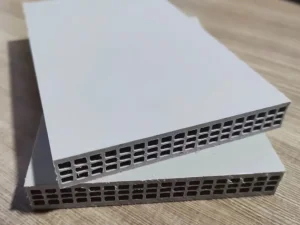
Enter Polypropylene (PP) Hollow Plastic Formwork—a high-polymer composite innovation engineered via high-pressure co-extrusion technology. Designed specifically to endure the extreme mechanical stresses and ambient variations of heavy civil and commercial building projects, PP formwork panels offer a non-porous, hydrophobic surface that achieves an unprecedented 60 to 100+ reuses under standard job-site handling protocols.
As a leading China PP formwork supplier & suppliers hub, modern Chinese manufacturing ecosystems have integrated Industry 4.0 automation, advanced polymer blending (incorporating nano-glass fiber reinforcement and specialized UV-stabilizing agents), and zero-defect quality control to deliver global-grade formwork panels at scales previously unattainable.
Macro Industry Development Trends Driving PP Plastic Formwork Adoption
Analyzing key market catalysts: ESG directives, labor demographic shifts, material science breakthroughs, and circular construction loops from 2025 to 2035.
1. ESG Mandates & Carbon Neutrality Requirements
Global architectural standards (LEED, BREEAM, Green Mark) now strictly penalize single-use timber formwork due to deforestation drivers. High-density PP hollow shuttering panels provide a 100% recyclable footprint. At the end of its 80+ cycle lifespan, scrap panels are re-granulated into raw resin pellets, fulfilling true circular economy compliance.
2. Labor Shortages & Demand for Ergonomic Systems
Aging skilled labor force in Europe, North America, and East Asia has forced construction engineering firms to favor lightweight materials. Standard 18mm PP hollow formwork panels weigh approximately 11.5 kg to 13 kg per square meter—significantly lighter than steel or solid hardwood systems—allowing single-worker manual positioning and accelerating floor-to-floor cycle times.
3. Nano-Toughened Polymer Formulation
Early-generation plastic shuttering suffered from thermal expansion and cold-weather embrittlement. Modern Chinese direct-factory compounding incorporates ethylene-propylene-diene monomer (EPDM) modifiers and organoclay reinforcements, extending operational thermal stability from -20°C up to +75°C without warping or edge cracking.
Global Procurement Evaluation: Technical Performance Matrix
Empirical engineering comparisons showing why multi-national EPC firms are shifting baseline specifications from traditional materials to polypropylene hollow shuttering boards.
| Key Performance Parameter | Polypropylene (PP) Hollow Panel | Marine Grade Plywood | Aluminum System Formwork |
|---|---|---|---|
| Typical Reuse Cycles | 60 – 100+ Times | 3 – 8 Times | 150 – 300 Times |
| Water Absorption Rate | 0.00% (100% Hydrophobic) | 18% – 25% (Delaminates) | 0.00% |
| Weight per m² (18mm) | 11.5 kg – 13.0 kg | 12.5 kg – 14.5 kg | 22.0 kg – 28.0 kg (Heavy) |
| Release Agent Needed | No (Self-Demolding Surface) | Yes (Mandatory every pour) | Yes (Mandatory every pour) |
| Nailing & Workability | Excellent (Standard Tools) | Excellent | Poor (Requires specialized pins) |
| Corrosion & Chemical Resistance | Immune to Acid/Alkali/Salts | Rots in humid environments | Oxidizes over time |
| Amortized Cost per Pour | Lowest (~$0.15 - $0.25 / m²) | High (~$1.20 - $2.50 / m²) | Medium High Initial CAPEX |
Note: Test data derived from standardized laboratory trials compliant with ISO 178 (Flexural Modulus) and ISO 179 (Charpy Impact Strength). Actual field reuses depend on handling quality, stripping procedures, and storage conditions.
China Factory 4.0: Modern Supply Chain Resilience & Precision Extrusion
How Chinese manufacturing hubs like Shuyang, Jiangsu combine automated raw polymer compounding, twin-screw co-extrusion lines, and port-adjacent logistics to deliver unparalleled supplier reliability.
Choosing the right China PP formwork supplier is not merely a pricing decision—it is a critical risk-management mandate for large-scale international projects. Unstable production parameters lead to panel thickness variations, hollow core wall collapse under concrete hydraulic head pressure, and severe surface waviness that ruins fair-faced concrete aesthetics.
Leading Chinese manufacturing facilities have overcome historical quality bottlenecks through three key pillars of industrial engineering:
1. Continuous Co-Extrusion Calibration
State-of-the-art twin-screw extrusion lines equipped with automatic ultrasonic wall-thickness gauges ensure that internal vertical rib structures maintain a uniform tolerance of less than ±0.2mm across the entire 1220x2440mm panel plane.
2. Raw Resin Polymer Chemistry
By utilizing virgin Polypropylene resin blended with controlled fractions of high-impact copolymers, Chinese factories create panels that balance flexural rigidity with fracture toughness, preventing nail-pullout tears and corner breakage during rapid stripping.
3. Integrated Port Logistics
Positioned near major East China deep-water ports (Shanghai, Lianyungang, Qingdao), Tier-1 suppliers maintain robust inventory levels and rapid container loading capabilities, reducing standard lead times to 7–15 days from order placement.
Localized Field Application Scenarios
Discover how engineered PP hollow plastic panels are customized to overcome site-specific challenges in diverse global construction environments.
A. High-Rise Commercial Slabs & Shear Walls
In high-density urban developments (e.g., Dubai, Singapore, Riyadh), rapid cycle times are mandatory. PP hollow formwork panels cut smoothly with standard circular saws, allowing custom framing around column drop heads and elevator cores. The self-demolding glossy surface yields a mirror-smooth fair-faced concrete finish that eliminates the need for manual plastering or skim-coating prior to painting.
B. Coastal & High-Humidity Infrastructure
Marine civil works, bridge piers, culverts, and sewage treatment facilities present aggressive chemical exposures. Unlike timber plywood which swells, delaminates, and rots under constant moisture, PP plastic shuttering panels maintain absolute dimension stability even when fully submerged or exposed to monsoon rains and high-salinity ambient air.
C. Modular Precast Concrete Plants
Precast concrete casting operations demand high turn-around velocity. PP hollow shuttering boards easily integrate into automated tilting tables and magnetic side-rail systems. Because concrete matrix slurry does not adhere to polypropylene, precast elements strip effortlessly without mechanical surface spalling or micro-cracking.
Frequently Asked Questions (FAQ) for B2B Buyers
Direct answers from our Senior Formwork Engineers regarding specification selection, job-site troubleshooting, and long-term procurement management.
Complete Sourcing Catalog & High-Demand Product Lines
Select your target product specification below to request direct factory quotes, technical datasheets, and container loading plans from our export service engineering team.