Featured Structural Formwork & Resilient Surfaces
Explore our high-performance engineered PP hollow shuttering boards and commercial interior vinyl systems, certified for extreme load capabilities and high-cycle reusability.
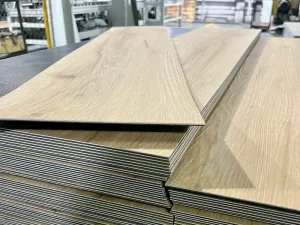
The Global Industrial Paradigm Shift in Concrete Shuttering & Surface Technology
Evaluating the transition from conventional timber and steel temporary structures to high-density polypropylene (PP) hollow formwork systems and resilient rigid-core composites.
Eradicating Timber Depletion
Traditional film-faced plywood forms degrade rapidly after 3 to 5 reuses due to moisture absorption, delamination, and mechanical wear. Plastic formwork panels engineered from modified Polypropylene (PP) achieve upwards of 50 to 100 reuses, dramatically cutting timber utilization and site waste in alignment with global ESG metrics.
Total Life-Cycle Cost Reduction
While initial unit cost per sheet for premium PP plastic formwork exceeds standard phenolic plywood, the cost-per-pour drops by 60% to 75%. Zero chemical release agent requirement, minimal cleaning labor, and high scrap recycling value transform temporary jobsite expenditure into capitalized operational savings.
Architectural Surface Excellence
Polymer non-porous surfaces prevent concrete water loss during hydration, ensuring uniform cement curing and eliminating surface honeycombing. Reaching Fair-Faced Concrete standards directly out of the form eliminates expensive secondary plastering and wall smoothing operations.
Polymer Architecture & 18mm Hollow-Core Rib Structural Analysis
An inside look at Greenstar's proprietary polypropylene extrusion technology, mechanical load distribution, and micro-structural resilience.
Structural Rib Topology & Load Distribution
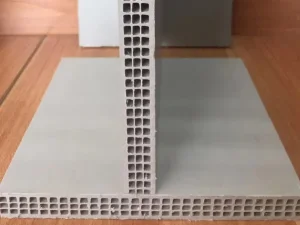
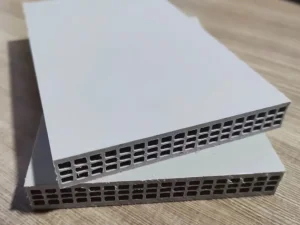
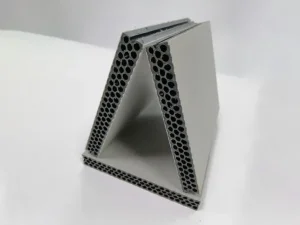
The performance of an 18mm PP hollow plastic formwork panel relies on its internal vertical web architecture. Greenstar’s 3,000㎡ R&D center optimized the rib-to-cavity ratio using Finite Element Analysis (FEA) to withstand hydrostatic concrete pressures up to 60 kN/m² under standard DIN 18218 testing protocols.
- Hollow Core Weight Reduction: Capping board mass at ~28 kg/m³ allows single-worker ergonomics without sacrificing flexural modulus.
- Web Thickness Consistency: Precision co-extrusion dies maintain a uniform wall thickness of 1.8mm (±0.05mm), preventing local bucking under high-vibration compaction.
- Isotropic Mechanical Strength: Multi-axial ribbing minimizes directional deflection variance between longitudinal and transverse spans.
Thermal Stabilization & UV Anti-Aging Chemistry
Polyolefins typically exhibit thermal expansion ($\Delta L = L \times \alpha \times \Delta T$). To counteract dimensional variance under intense sunlight or ambient freeze-thaw conditions, Greenstar incorporates specialized Nano-CaCO3 reinforcement and hindered amine light stabilizers (HALS).
Operational Temperature Envelope: Stable structural integrity maintained from -20°C to +90°C without brittle fracture during winter pours or wave-like surface expansion under tropical sunlight.
The non-polar hydrophobic surface naturally repels alkaline cementitious slurries, rendering mechanical scraping obsolete and allowing simple high-pressure water washdowns.
Technology Evolution Roadmap (2020 - 2028+)
Solid Polyolefin Composites
Heavy weight per panel, susceptible to thermal warping; targeted low-rise horizontal pours.
Standard Square-Hollow PP Board
Weight reduced by 35%. Introduced internal cross-ribs to elevate lateral flexural load resistance.
Co-Extruded Glass Fiber Reinforced PP
Nano-glass fiber reinforced skins, zero swelling, 100+ reuses, high impact resilience under pump pressure.
Smart Embedded Sensor Formwork
Integrated IoT sensors for real-time hydration heat, lateral pressure, and concrete strength telemetry.
Localized Application Protocols Across Complex Construction Environments
From high-rise vertical core walls to subterranean foundations, discover how PP hollow plastic panels adapt to field stresses.
High-Rise Vertical Core Walls & Elevator Shafts
In high-rise construction, crane time and cycle speeds are critical metrics. Lightweight 18mm PP panels fit standard climbing formwork frames. Because panels do not absorb water, their weight remains static pour after pour, preventing crane load recalibration. Standard woodworking saws and nail guns can cut apertures for tie-rods and conduit penetrations without panel edge splintering.
Subterranean Foundations & High-Moisture Works
Subterranean footings, basement retaining walls, and drainage culverts subject temporary formwork to constant groundwater, mud, and high humidity. Where timber plywood rots, delaminates, and expands (causing joint misalignment), hollow PP panels remain immune to moisture. Their zero-water-absorption coefficient prevents concrete paste loss, producing void-free waterproof basement shells.
Bridge Abutments, Civil Tunnels & Marine Structures
Infrastructure civil engineering demands smooth, durable concrete surfs resistant to freeze-thaw spalling and salt ingress. The ultra-smooth polymer skin of PP shuttering boards leaves a dense, non-porous surface finish. Panels can be pre-curved for arched tunnel linings or radius piers without steam bending or special chemistry.
Comprehensive B2B Materials Evaluation Matrix
Engineering comparison between standard plywood, steel shuttering, PP hollow plastic panels, and interior resilient flooring products (LVT/SPC).
| Performance Metric | Phenolic Plywood | PP Hollow Formwork (18mm) | SPC Vinyl Flooring | LVT Vinyl Flooring |
|---|---|---|---|---|
| Primary Composition | Wood Veneer + Phenolic Glue | Modified Polypropylene (PP) | CaCO3 Stone Powder + PVC Matrix | Polyvinyl Chloride (PVC) Polymer |
| Reusability / Lifecycle | 3 - 5 Cycle Average | 50 - 100+ Cycles | 25-Year Commercial Rating | 15-Year Commercial Rating |
| Water Absorption Rate | 12% - 25% (High Swelling) | < 0.01% (Impervious) | 0.00% (100% Waterproof) | 0.00% (Waterproof Core) |
| Bending Modulus / Rigidity | Moderate (Degrades wet) | High Flexural Rigidity | Ultra-Rigid Core (>1800 kg/m³) | Flexible / Semi-Rigid |
| Chemical / Alkali Resistance | Low (Attacked by cement paste) | Extreme Inertness | High Resistance | High Resistance |
| Installation Method | Nail / Screw / Timber Joist | Standard Carpentry Tools | Unilin Click-Lock Floating | Glue-Down / Dry Back |
| Environmental Recyclability | Non-Recyclable Landfill | 100% Melt Recyclable | 100% Recyclable Core | Recyclable Polymer |
Supply Chain Resilience & Modern Extrusion Capabilities in Shuyang
Inside Greenstar New Materials Shuyang Co., Ltd.: Integrated polymer synthesis, continuous high-speed extrusion, and ocean freight logistics.
8 Continuous High-Speed Extrusion Lines
Located in Shuyang County, Suqian City, Jiangsu Province, our facility operates 8 automated extrusion production lines dedicated to PP hollow formwork panels, SPC rigid core planks, and LVT sheet goods. Continuous online ultrasonic gauging guarantees panel thickness tolerances within ±0.2mm across standard 1220x2440mm sheets.
3,000㎡ Specialized R&D & QA Testing Lab
Every batch of virgin and modified polypropylene resin undergoes melt flow index (MFI) analysis, Charpy impact resistance testing, and dynamic mechanical thermal testing (DMTA). Over 100 chemical formulations have been developed to match local climatic extremes—from Middle Eastern desert heat to Nordic winter cold.
Streamlined Port Freight Logistics & 7-15 Day Dispatch
Proximity to Shanghai and Lianyungang deepwater ports enables rapid container drayage. Standard inventory items and high-volume orders feature an agile turnaround of 7 to 15 days from PO confirmation. Our export network spans over 40 countries across North America, Europe, SE Asia, and the Middle East with an 85%+ repeat order rate.
Global Regulatory Compliance & On-Site Support Standards
Meeting international structural engineering and environmental health mandates for international tenders.
Testing Metrics & ASTM Standards
Greenstar PP hollow plastic formwork boards are tested according to:
- ASTM D638: Tensile Strength & Elongation At Yield
- ASTM D790: Flexural Modulus and Bending Rigidity
- DIN 18218: Dynamic Concrete Pressure Resistance
- EN 13329: Abrasion & Impact Resistance (Flooring Range)
Environmental & Safety Certifications
Full adherence to global ESG standards and indoor air quality safety:
- ISO 9001 / ISO 14001: Certified Production & Environmental Mgmt
- REACH & RoHS Compliance: Zero Heavy Metals or Phthalates
- CE Mark Certification: European Union Commercial Access
- FloorScore® Certified: Low VOC Emissions for Indoor Vinyl Range
Customized OEM & Pre-Cut Services
Custom engineering solutions for major contractors and distributors:
- CNC Precision Sizing: Custom dimensions up to 3000mm length
- Private-Label Printing: Logo branding and grid alignment markings
- Sealed Edge Treatments: Factory edge-welding for subterranean pours
- On-Site Technical Consultation: Shuttering layout optimization
Frequently Asked Questions by Contractors & Distributors
In-depth technical responses addressing procurement, site handling, reusability testing, and chemical compatibility.
How does 18mm PP hollow plastic formwork achieve 50 to 100+ reuses compared to standard timber plywood?
Traditional timber plywood relies on organic veneers held together by resin glue. When exposed to wet concrete paste, moisture absorption causes swelling, edge delamination, and mechanical rot, limiting reuse to 3–5 cycles. In contrast, Greenstar’s PP hollow formwork is extruded from modified Polypropylene—an inorganic polymer matrix with near-zero water absorption (<0.01%). The solid surface skin is impervious to alkaline cement reactions, and the vertical ribbing structure distributes mechanical vibrations evenly. As long as standard stripping tools (plastic wedges/crowbars) are used, panels withstand dozens of successive pours without structural breakdown.
Is chemical form release agent (mold oil) required when using plastic shuttering panels?
No, chemical release agents are completely unnecessary. Polypropylene possesses a naturally low surface energy and non-polar molecular structure, preventing concrete slurry from adhering to the board. Once concrete cures, formwork panels strip easily away from the concrete wall or slab face. Eliminating chemical oil application saves significant labor hours, material cost, and avoids oily residues that interfere with downstream architectural coatings or waterproofing membranes.
How do workers handle site modification, such as cutting, drilling, and nailing plastic formwork?
PP hollow formwork panels process identically to traditional timber formwork using standard woodworking power tools. Carpenters can cut boards with handheld circular saws, drill holes for tie-rod sleeves, and drive steel nails into joists. Because the material is tough and non-brittle, nails grip firmly without cracking the face skin or causing edge blowouts. Upon stripping, nail holes can be filled with specialized plastic plugs or hot-melt polymer rods to maintain water tightness for the next pour.
What is the structural load capacity and deflection behavior under high pour speeds?
At standard 18mm thickness, our hollow PP formwork supports concrete lateral hydrostatic pressures exceeding 60 kN/m² when installed on typical 300mm joist spacing. The internal I-beam style structural ribs prevent localized bulging. Under wet concrete density loads (~24 kN/m³), flexural deflection remains well within international architectural limits (< L/400), ensuring straight, plumb wall surfaces without wave deformation.
How does thermal expansion affect PP plastic formwork in extreme summer heat or winter cold?
Polyolefins expand in high heat and contract in extreme cold. Greenstar counters this by introducing inorganic micro-reinforcements (CaCO3 nano-composites) that lower the coefficient of thermal expansion. Furthermore, field assembly guidelines recommend leaving a 1mm to 2mm expansion gap at panel joints during hot weather installations, or sealing joints with PVC foam tape. In winter (-20°C), anti-impact additives prevent cold-embrittlement during form stripping.
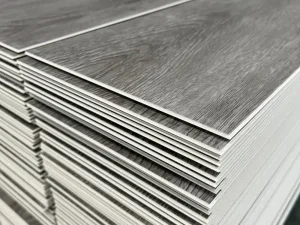
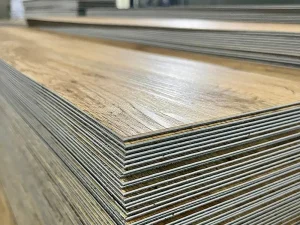
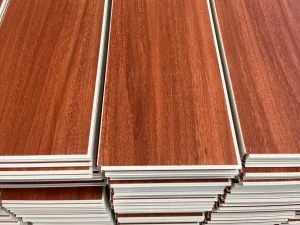
What are the primary differences between LVT and SPC flooring supplied by Greenstar?
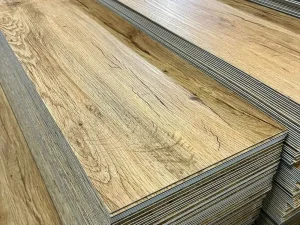
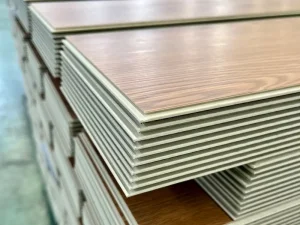
LVT (Luxury Vinyl Tile) features a flexible multi-layer PVC structure, ideal for glue-down commercial applications where sound absorption and soft foot-feel are prioritized. SPC (Stone Plastic Composite) incorporates a high-density rigid core made of 70% natural limestone powder and 30% PVC resin. SPC offers ultra-high dimensional stability, superior dent resistance, 100% waterproof performance, and floating click-lock installation ideal for high-traffic or high-moisture interiors.
Can scrap or damaged plastic formwork panels be recycled after completing a multi-story project?
Yes, 100% of our PP plastic formwork panels are recyclable. After completing its lifecycle on site, damaged or off-cut boards can be cleaned, crushed, and re-granulated into recycled polypropylene pellets. Greenstar offers a factory buy-back or credit program for end-of-life panels, enabling contractors to recover scrap value while fulfilling zero-landfill environmental commitments.
What are your standard lead times, packing specs, and minimum order quantities (MOQ)?
Our standard MOQ is typically one 20-foot container (~400 to 450 sheets of 18mm 1220x2440mm formwork). Panels are strapped onto wooden or polymer pallets with protective corner guards and waterproof stretch wrapping for ocean transit. Standard orders dispatch in 7 to 15 days. Customized colors, pre-cut dimensions, or mixed-container shipments (combining formwork and flooring) can be arranged with our sales engineering team.
Full Range Polymeric Formwork & Interior Surface Solutions
Review our comprehensive product catalog items with factory-direct export terms and complete technical data packages.