
Featured Industrial Product Range
Direct Factory Export Lines & Engineered Construction Panels
1. Global Industrial Status & Demand Architecture
Analyzing Macroeconomic Shifts, Commercial Adoption Rates, and Structural Material Evolution in Modern Architecture
The global interior surfacing and architectural envelope sector is undergoing a profound paradigm shift. Traditional wall treatments—such as natural timber paneling, mined stone veneer, plasterboard, and ceramic tiling—are increasingly constrained by escalating labor costs, environmental harvesting restrictions, long installation timelines, and susceptibility to moisture degradation. In response, modern architectural specifications globally are favoring high-performance synthetic materials, with Wall Cladding PVC Panels emerging at the forefront of this industrial transformation.
Engineered polyvinyl chloride (PVC) wall systems represent a synthesis of chemical durability, precision extrusion manufacturing, and aesthetic versatility. Globally, the market for PVC wall panels is expanding at an unprecedented Compound Annual Growth Rate (CAGR) exceeding 7.8% over the 2024–2030 forecast window. Driving factors include rapid urbanization across the Asia-Pacific region, stringent moisture and hygiene mandates in North American commercial infrastructure, and aggressive energy-retrofit regulations across European Union real estate assets.
North American Commercial Market
Driven by strict healthcare regulations, multi-family development speeds, and high labor costs. Wall cladding PVC panels are specified for high-occupancy environments, healthcare corridors, and hospitality retrofits due to quick tongue-and-groove interlocking profiles.
European Sustainable Retrofits
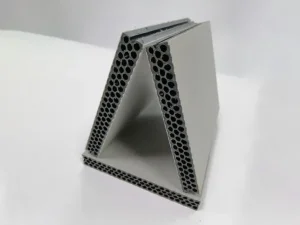
EU directives prioritize circular economy characteristics, low VOC emissions (E0/Greenguard standards), and thermal efficiency gains. Recyclable PVC formulations with micro-hollow cell structures provide secondary acoustic insulation while satisfying strict REACH protocols.
Emerging Belt & Road Infrastructure
Rapid mega-projects across Southeast Asia, the Middle East, and Latin America demand lightweight wall cladding that withstands high humidity and thermal fluctuations without warping, expanding, or supporting mold colonies.
2. Engineering Precision & China Manufacturing Supremacy
Dissecting Material Formulations, Extrusion Dynamics, and Economies of Scale from Shuyang Industrial Hubs
As global sourcing mandates require tighter tolerances, guaranteed delivery schedules, and rigorous quality assurance, China’s industrial manufacturing infrastructure has established unparalleled operational superiority in polymer extrusion technology. Facilities located in major manufacturing hubs such as Shuyang, Jiangsu Province—exemplified by enterprise centers like Greenstar New Materials Shuyang Co., Ltd.—integrate end-to-end production chains that merge advanced R&D, chemical engineering, multi-cavity extrusion, high-definition decorative hot-stamping, UV surface treatment, and precision profiling under a unified Quality Management System (ISO9001 / ISO14001).
Industrial Insight: The Anatomy of High-Performance PVC Wall Panels
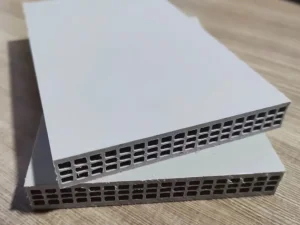
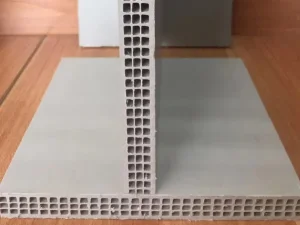
A premier Wall Cladding PVC Panel is not a monolithic plastic sheet. It is a multi-layered composite matrix engineered for dimensional equilibrium. The core consists of high-purity micro-calcium carbonate (CaCO3) blended with Polyvinyl Chloride resin at scientifically calibrated ratios, reinforced with non-toxic heat stabilizers and impact modifiers. The top surface utilizes high-definition decorative films capped with dual-cured polyurethane UV coatings that provide exceptional scratch resistance and color fastness.
Advanced Extrusion Lines
Utilizing high-torque twin-screw extruders operating with automated gravimetric dosing. This guarantees consistent core wall thickness, eliminates internal voids, and maintains cell-structure uniformity across massive volume runs.
In-Line Surface Engineering
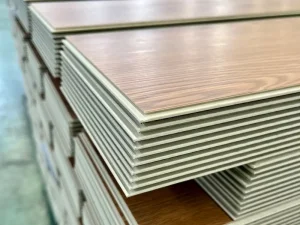
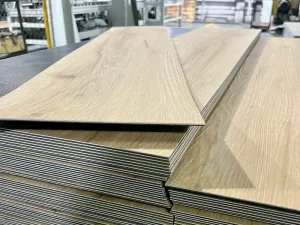
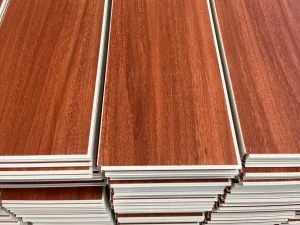
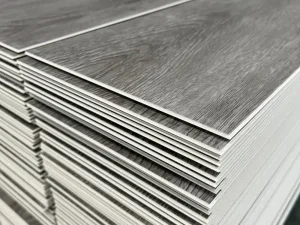
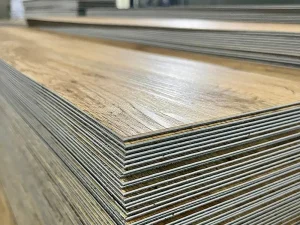
Integrated hot-stamping, thermal transfer printing, and high-definition film lamination technologies allow replication of rare hardwood grains, natural Italian marble, micro-cement, and metallic textures with 3D tactile embossing.
Rigorous Quality Auditing
Continuous testing for tensile strength, impact resistance, boiling water immersion stability, thermal expansion coefficients, and flame spread indices ensuring absolute batch-to-batch consistency for international procurement networks.
3. Micro-Application Scenarios & Architectural Integration
From Commercial Cleanrooms to High-End Interior Architecture: Universal Performance Profiles
Healthcare & Laboratory Environments
In medical centers and cleanrooms, non-porous antibacterial PVC wall panels eliminate grout lines where pathogens harbor. Impervious to chemical disinfectants, chlorine solutions, and frequent high-pressure sanitation.
Wet Area Commercial Interiors
Ideal for commercial kitchens, indoor aquatic centers, hotel bathrooms, and underground transit hubs. Unlike drywall or MDF paneling, PVC panels exhibit 0.00% moisture absorption, permanently preventing rot and structural degradation.
Acoustic Slat & Feature Wall Design
Utilizing fluted, WPC, and 3D geometric PVC profiles for office lobbies, luxury retail boutiques, and auditorium accents. Delivers high aesthetic impact, reduced echo, and rapid dry-wall construction over raw masonry.
4. Technical Specification Matrix & Sourcing Guidelines
Comprehensive Material Benchmarks for Architects, Engineers, and Importers
| Performance Metrics | Wall Cladding PVC Panels | WPC Wall Panels | MDF / Wood Paneling | Fiber Cement Board |
|---|---|---|---|---|
| Moisture Resistance | 100% Waterproof (0% Absorption) | High Water Resistance (<1% Absorption) | Poor (Absorbs & Swells) | Water Resistant (Heavy) |
| Fire Safety Standard | B1 Class / Flame Retardant | B1 - B2 Class | C - D Class (Combustible) | A1 Non-Combustible |
| Weight per Sq. Meter | Lightweight (2.2 - 4.5 kg/m²) | Medium (5.5 - 8.5 kg/m²) | Medium-Heavy (6 - 10 kg/m²) | Very Heavy (12 - 18 kg/m²) |
| Installation Method | Interlocking Tongue & Groove | Clip System / Adhesive | Nailing / Framing Required | Heavy Mechanical Fasteners |
| Formaldehyde Emission | E0 Grade / Zero Formaldehyde | E0 - E1 Grade | E1 - E2 Grade (Binder dependent) | Zero Formaldehyde |
| Insect / Mold Immunity | Complete Immunity | Complete Immunity | Vulnerable to Termites / Fungi | Complete Immunity |
Procurement Director's Quality Control Checklist:
- Density & Wall Thickness Integrity: Verify outer shell thickness and internal rib alignment. Substandard panels reduce rib count to cut weight, severely compromising impact strength.
- UV Lacquer Curing Depth: Request scrub-test data. Quad-cured UV coatings prevent yellowing under intense indoor ambient lighting or direct window sunlight.
- Thermal Cycling Stability: Demand dimensional change tests under thermal stress (-15°C to +65°C cycling) to ensure lock joints won't pop in unconditioned buildings.
5. Industry Roadmap & Future Technology Trends
Next-Phase Material Evolution: Eco-Formulations, EIR Texturing, and Smart Wall Systems
Embossed-in-Register (EIR) Surface Tech
Advanced optical sensors sync the tactile micro-texture directly with the visual print film below, delivering authentic tactile renditions of brushed timber, raw slate, and hammered metals indistinguishable from organic matter.
Zero-Carbon Bio-Polymer Formulations
Transitioning toward calcium-zinc eco-stabilizers and bio-based PVC resins derived from circular bio-feedstocks, satisfying stringent carbon footprint audits for LEED Platinum green building projects.
Integrated Acoustic Core Layers
Pioneering micro-perforated acoustic backing webs combined with foam-core PVC backing that trap sound waves, achieving NRC (Noise Reduction Coefficient) ratings above 0.65 for modern office spaces.
6. Technical FAQ & Sourcing Clarifications
Direct Answers to Critical Sourcing, Engineering, and Logistics Questions
Complete Product Lines & Construction Solutions
High-Performance Materials Exported Worldwide