
Moscow Market Priority Product Line
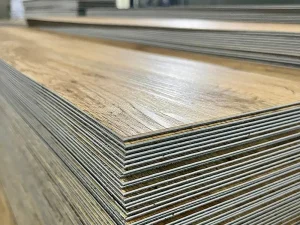
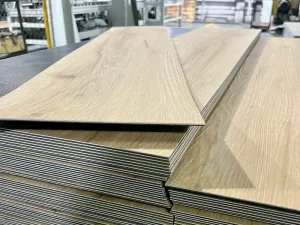
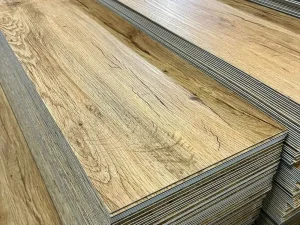
Direct-factory resilient flooring solutions specifically formulated to withstand the rigorous freeze-thaw cycles, high foot-traffic, and stringent fire safety standards (KM2/KM3) required in Russian commercial developments.
Macro-Economic Dynamics & Commercial Flooring Demands in Moscow
The Greater Moscow metropolitan area represents the largest commercial real estate, logistics, and residential renovation market in Eastern Europe and Central Eurasia. As infrastructure modernization accelerates across key Moscow districts—ranging from the expanding commercial hubs in Moscow City (MIBC) to industrial logistics corridors around Domodedovo, Sheremetyevo, and the Central Ring Road (CKAD)—the demand for resilient, high-performance interior surfacing materials has reached an unprecedented scale.
Commercial architects, procurement directors, and general contractors in Moscow face unique structural challenges. Traditional flooring substrates such as natural timber, ceramic tiles, and low-density linoleum present severe operational drawbacks when deployed in northern continental climates:
- Thermal Instability & Sub-Zero Transit Impact: Building materials imported into Moscow frequently undergo rapid thermal shifts during winter transit (with temperatures dropping below -25°C) to indoor climate-controlled environments (+22°C). Low-grade polymer flooring often suffers from micro-cracking and brittleness.
- Radiant Heating Compatibility Requirements: Over 85% of modern Moscow residential developments and commercial offices integrate hydronic or electric underfloor radiant heating systems. Flooring materials must maintain structural dimensional stability ($\le 0.10\%$ dimensional change) without emitting volatile organic compounds (VOCs) under sustained heat exposure.
- Heavy De-icing Chemical Foot-Traffic: During the extended winter season, public entrances, shopping malls (e.g., AviaPark, Metropolis), and administrative centers experience concentrated tracking of calcium chloride de-icing salts, slush, and abrasive grit. Surface coatings must possess superior chemical resistance and EN 660-2 Group T wear levels.
Chemical Engineering & Technical Blueprint of Commercial LVT
A rigorous engineering breakdown of our Luxury Vinyl Tile (LVT) formulations, highlighting dimensional stabilization, wear layer physics, and ecological safety certifications tailored for Russian technical regulations.
UV-Crosslinked PUR Wear Layer
Engineered with double-cured polyurethane infused with microscopic aluminum oxide ($\text{Al}_2\text{O}_3$) ceramic beads. Provides exceptional resistance against scratch wear, scuff marks, and harsh salt staining common in Moscow winters.
High-Density Virgin PVC Core
Utilizes 100% un-recycled virgin polyvinyl chloride resin suspension mixed with precision-grade calcium carbonate ($\text{CaCO}_3$). Ensures zero toxic off-gassing, high static load performance ($\ge 2.5\text{ MPa}$), and immunity to subfloor residual moisture.
Fiberglass Stabilization Network
Encapsulated ultra-fine glass fiber fleece sandwiched between PVC core layers. Controls expansion and contraction vectors during severe internal temperature drops, ensuring zero cupping or joint disengagement in Moscow heating seasons.
Technical Performance Specification Matrix
Comparative structural parameters for commercial procurement managers evaluating LVT vs SPC systems for Moscow facilities:
| Physical Parameter | Commercial Dryback LVT (2.5mm / 0.55mm) | Click-Lock LVT (4.2mm / 0.55mm) | Rigid Core SPC (5.0mm / 0.55mm + IXPE) |
|---|---|---|---|
| Density Profile | $\approx 1,450 \text{ kg/m}^3$ | $\approx 1,500 \text{ kg/m}^3$ | $\approx 2,000 \text{ kg/m}^3$ |
| Dimensional Stability (EN 434) | $\le 0.08\%$ (Heat treated) | $\le 0.06\%$ | $\le 0.02\%$ (Maximum stability) |
| Acoustic Impact Reduction (ISO 10140) | 4 dB (Direct Glue) | 12 dB | 19 dB - 21 dB (with integrated IXPE pad) |
| Fire Rating (GOST 30244 / FZ-123) | KM2 / KM3 Certified | KM2 Certified | KM2 Certified (Bfl-s1 equivalent) |
| Subfloor Imperfection Tolerance | Low (Requires smooth self-leveler) | Moderate | High (Bridges minor telegraphing) |
| Underfloor Heating Compatibility | Optimal (Rapid heat transfer) | Excellent ($\le 27^\circ\text{C}$ surface limit) | Excellent (Low thermal resistance) |
Eurasian Supply Chain Optimization & Logistics to Moscow
Navigating cross-border supply chains to the Russian Federation demands robust logistics planning, strict regulatory compliance, and reliable lead-time execution. As an experienced exporter of LVT flooring and construction formwork systems, our factory provides fully integrated supply chain protocols tailored for Moscow importers, wholesalers, and project managers.
1. Multimodal Rail & Sea Transportation Routes
We leverage established transport corridors ensuring seamless freight passage from our manufacturing facility directly to major Moscow customs terminals (e.g., Vorsino, Khovrino, Silikatnaya):
- Direct Railway Freight (Trans-Siberian / Silk Road Line): Containerized shipments routed through Manzhouli/Zabaykalsk or Khorgos directly to Moscow. Transit time ranges from 14 to 20 days.
- Combined Sea-Rail Freight via Vladivostok/Vostochny: Maritime shipping to Russian Far East ports, followed by express container rail to Moscow logistics hubs. Transit time ranges from 22 to 28 days.
2. Customs Certification & Regulatory Compliance (EAC & Fire Safety)
Importing polymer surfacing products into the Eurasian Customs Union (EACU) requires strict technical documentation. Our export compliance department guarantees that all delivered consignments include:
- EAC Declaration of Conformity: Verifying compliance with TR CU safety standards for synthetic building materials.
- Federal Law No. 123-FZ Fire Safety Certification: Lab testing documentation confirming flammability (G1/G2), smoke generation (D2), toxic combustion product hazard (T2), and flame spread resistance (RP1/RP2), satisfying Moscow municipal fire codes for public infrastructure.
- Sanitary-Epidemiological Expert Conclusion: Guaranteeing non-toxicity, zero formaldehyde emission, and low chemical volatility suitable for educational and healthcare deployments.
Targeted Macro Solutions for Moscow Commercial Sectors
Custom-tailored material specifications designed for specialized architectural projects across the Greater Moscow region.
Moscow Commercial Offices & Class-A Towers
Acoustic LVT with integrated IXPE sound dampening. High static load resistance prevents indentation from modular office furniture, heavy desks, and rolling casters (EN 425 certified).
Retail Megamalls & Supermarkets
0.55mm deep-embossed wear layer LVT planks engineered for constant rolling cart traffic, heavy footfall, and continuous wet maintenance using alkaline detergent scrubbing equipment.
Hospitality & Luxury Residential Complexes
High-definition Embossed-in-Register (EIR) wood and stone surface textures giving the tactile warmth of natural Siberian Oak or Marble without susceptibility to moisture rot or shrinkage.
Synergistic Construction Materials: PP Hollow Plastic Formwork for Moscow Cast-in-Place Structures
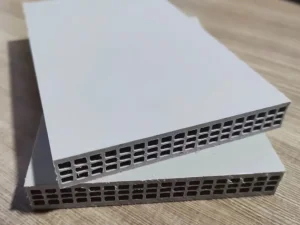
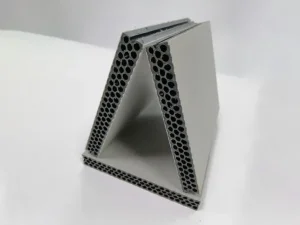
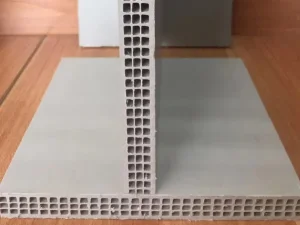
Beyond interior flooring, our group manufactures 18mm Polypropylene (PP) Hollow Plastic Formwork panels widely specified in Moscow residential high-rise concrete casting and infrastructure development. Engineered to replace traditional birch plywood, our PP formwork panels offer over 60 reuse cycles, complete moisture immunity, and smooth concrete releases even in freezing pour conditions.
Explore Formwork SpecificationsTechnology Roadmap: Next-Gen Polymer Surfacing (2025–2030)
As the international flooring industry pivots toward environmental sustainability, digital printing, and advanced acoustic dampening, our R&D center is actively implementing technological upgrades across all upcoming production cycles:
Bio-Based Non-Phthalate Plasticizers
Transitioning from traditional plasticizers to soybean-oil and castor-oil derived bio-esters. Reduces carbon intensity during synthesis while improving low-temperature flexibility during transit across Russian regions.
Digital Scanning & Direct Optical Embossing
Deploying 600 DPI direct-to-film optical scanning systems that synchronize visual wood grain motifs with physical tactile grooves to within $\pm 0.1\text{mm}$ spatial precision.
Closed-Cell Micro-Foam Underlays
Co-extruding lightweight, ultra-high-density acoustic foam backings directly onto LVT click profiles, eliminating the need for separate subfloor underlayment during Moscow site installation.
Zero-Waste Post-Industrial Reclamation
Establishing closed-loop recycling loops where post-construction LVT trim waste is re-processed into dense sub-layer cores without compromising tensile strength or structural integrity.
Dedicated B2B Support for Greater Moscow Buyers
We provide comprehensive direct-factory technical and commercial support to ensure smooth procurement cycles for distributors and major construction enterprises in Russia.
Rapid Architectural Sampling
Express dispatch of physical sample boxes—including physical decor swatches, wear layer cross-section cuts, and click profile joinery—delivered directly to your Moscow office or job site within 5 to 7 business days.
Customized OEM & Private Label
Tailored packaging design, custom brand printing on protective backing films, customized box dimensions, and specialized decor developments tailored to Russian market design trends.
Direct Engineering Consultation
Access our team of technical specialists for subfloor moisture testing advice, adhesive selection guidelines for dryback LVT, and structural load calculations for major municipal developments.
Frequently Asked Questions (FAQ) - Moscow Procurement Guide
Detailed technical responses to common engineering and commercial queries from Russian flooring distributors, importers, and project developers.
For heavy commercial applications such as shopping centers, office corridors, and educational institutions in Moscow, a wear layer thickness of 0.55mm (22 mil) with a UV-crosslinked polyurethane coating containing aluminum oxide micro-ceramics is strongly recommended. This achieves a Commercial Class 33 / Industrial Class 42 usage rating, resisting abrasive wear from sand and de-icing salt grit tracked in during winter months.
Both LVT and SPC are fully compatible with modern underfloor radiant heating systems prevalent in Moscow. However, the surface temperature should be regulated not to exceed 27°C (80°F). SPC offers slightly higher dimensional stability under rapid heat cycles due to its rigid limestone-polymer core, whereas dryback LVT offers superior heat transfer efficiency when installed using heat-resistant acrylic adhesives.
Our commercial LVT and SPC flooring products are tested in accordance with Federal Law No. 123-FZ fire safety requirements, achieving KM2 rating parameters (Flammability G1, Toxicity T2, Smoke Generation D2, Flame Spread RP1). This satisfies municipal building code regulations for commercial corridors, hotels, office buildings, and retail environments across Russia.
Standard factory production lead time is 7 to 15 days following order confirmation and decor selection. Direct rail container transit from our plant to Moscow customs terminals typically requires 14 to 20 days. Minimum order quantities (MOQ) start at 1,000 square meters per decor design, with full container loads (20ft FCL) optimizing freight cost efficiency.
Our 18mm Polypropylene (PP) Hollow Formwork offers over 60 reuse cycles compared to 3-5 cycles for standard plywood. Furthermore, PP formwork panels do not absorb water, eliminating swelling, delamination, or freeze cracking during winter concrete pours in Moscow, ultimately reducing formwork cost-per-pour by up to 60%.
Complete Moscow Commercial Product Portfolio
Explore our full catalog of resilient polymer flooring and heavy-duty structural formwork systems engineered for export to Russian and Eurasian markets.
Ready to Source Direct-Factory LVT Flooring for Your Moscow Projects?
Partner with an established manufacturer offering 15+ years of export expertise, direct railway logistics to Moscow, complete EAC fire safety certification, and custom private-label solutions.
Send Inquiry Now